Tabletop Companion
en
← Learn

Field guide

How to play Secret Hitler

5–10 players — the Liberals always outnumber the Fascists, and always know less Light — a hidden-role social deduction party game of voting and bluffing

What is Secret Hitler?

Secret Hitler is a hidden-role game set in 1930s Germany, where a table of politicians tries to hold a fragile government together. At the start of the game every player is secretly dealt a role: most are Liberals, a few are Fascists — and one of them is Hitler. The Liberals hold the majority, but they don't know who anyone is; the Fascists know each other and work from the shadows to sow distrust and put their leader in power.

Each round the table elects a President and a Chancellor, and that government enacts a policy drawn from a shuffled deck — but the deck is stacked with fascist policies, and only the two people in the government know what was really drawn and what was quietly discarded. Every enacted policy tightens the screws: fascist policies grant the President dark new powers — investigating loyalties, even executing players. Trust no one fully, read every vote, and remember: the person acting the most liberal might be exactly who you fear.

Never played a hidden-role game? Here's the shape of it. You will spend the game making claims that cannot be verified, and listening to others do the same. That's not a flaw — the game is a machine for generating testimony and then testing it. A Liberal's job is to notice which stories stop fitting together; a Fascist's job is to keep theirs fitting just long enough.

Components

What's in the box, and what each piece does at the table:

  • 3 Liberal/Fascist boards — each has the Liberal track on one side and a Fascist track sized for 5–6, 7–8, or 9–10 players on the other. Choose the Fascist track matching your count and set it beside any Liberal track. The Fascist track is where the presidential powers are printed, so the board itself tells you exactly how dangerous each future fascist policy will be.
  • 17 policy tiles (11 Fascist, 6 Liberal) — the deck the whole game is drawn from. That 11-to-6 imbalance is deliberate and public: fascist policies will pass honestly, which is precisely what gives a lying Fascist government cover.
  • 1 draw pile card + 1 discard pile card — the two placemats the deck and discards sit on. Discards stay face down forever, which is what makes a President's claim about what they discarded unverifiable.
  • 10 secret role cards (Liberal, Fascist, Hitler) — your true identity, shown only at game end (or when Hitler is executed).
  • 10 party membership cards — your public loyalty, shown when investigated. Crucially, Hitler's membership card just says "Fascist" — an investigation can catch Hitler's team, but never Hitler specifically.
  • 10 card envelopes — hold each player's role, membership, and ballots so nothing leaks during the deal.
  • 10 Ja! + 10 Nein! ballot cards — one pair per player. Everyone votes face down and reveals at once, so nobody can follow the room.
  • 1 President placard + 1 Chancellor placard — mark the current government, and the two people who are term-limited next round.
  • 1 election tracker marker — counts failed elections. On the third, the country falls into chaos and the top policy enacts itself with nobody to blame.

Setup

  1. Pick the board for your player count. The liberal track is always the same; the fascist track (5–6, 7–8, or 9–10 players) determines which presidential powers unlock as fascist policies pass. Point at the powers and name them aloud before you start — the whole table should know that, say, the fifth fascist policy means someone gets shot.
  2. Build the policy deck: shuffle 6 Liberal and 11 Fascist policy tiles face down and place the deck on the draw pile card.
  3. Deal secret envelopes. Each player gets a secret role card and a matching party membership card (Hitler's membership card says only "Fascist" — investigations never reveal Hitler directly), plus a Ja! and a Nein! ballot card. The role mix depends on player count: 5) 3 Liberals, 1 Fascist + Hitler · 6) 4L, 1F + H · 7) 4L, 2F + H · 8) 5L, 2F + H · 9) 5L, 3F + H · 10) 6L, 3F + H. Fill the envelopes, then shuffle them and hand them out at random — packing them in front of the table is the classic way to spoil a game.
  4. Everyone closes their eyes for the reveal ritual:

    With 5–6 players: the Fascist and Hitler open their eyes and acknowledge each other.

    With 7–10 players: Hitler keeps eyes closed with a thumb up; the other Fascists open their eyes, find each other, and see who Hitler is. Hitler does not learn who the Fascists are.

    Have one person read the ritual aloud, slowly, and make everyone drum the table throughout — the noise hides the sound of heads turning. 5. Everyone opens their eyes, and a random player becomes the first Presidential candidate — hand them the President placard.

How to play

The game is played in rounds, and every round has three parts: an Election, a Legislative Session, and — sometimes — an Executive Action.

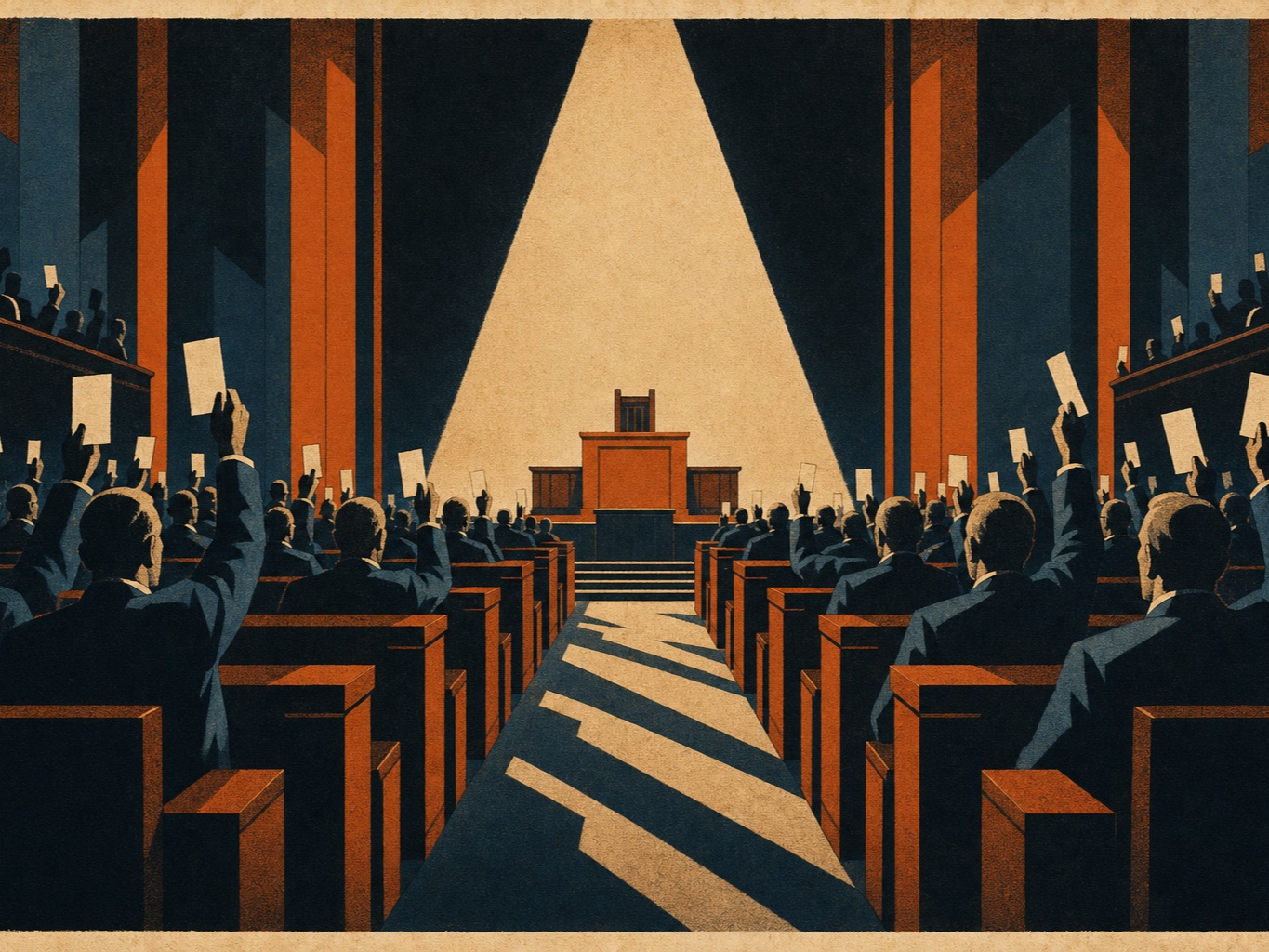
Election. The President placard passes clockwise. The candidate nominates a Chancellor (the last elected President and Chancellor are term-limited and ineligible; with 5 players only the last elected Chancellor is). After open discussion, everyone votes at once with Ja!/Nein! ballots. A majority of Ja! elects the government; a tie fails. Each failed election advances the Election Tracker — and on the third consecutive failure the country is thrown into chaos: the top policy of the deck is enacted immediately, no power triggers, and term limits reset.

Legislative Session. The President draws the top 3 policy tiles, secretly discards 1, and passes the other 2 to the Chancellor, who secretly discards 1 and enacts the last one face up. No table talk, no signals — and discards stay secret forever, which is where the lying begins. If fewer than 3 tiles remain in the deck, shuffle the discard pile back in.

Executive Action. If a fascist policy lands on a space with a presidential power, the President must use it before the round ends: Investigate a player's party membership, call a Special Election, peek at the top 3 policies, or execute a player — who is out of the game and reveals nothing.

Once 3 fascist policies are on the board, the Fascists gain a knife's-edge threat: electing Hitler as Chancellor wins them the game — so every nomination from then on is a matter of life and death. After 5 fascist policies, governments gain veto power: the Chancellor may propose discarding the whole agenda, and if the President agrees, nothing is enacted (and the Election Tracker advances).

A round, played out. Ana is President and nominates Beto; the table elects them 5-2. Ana draws three tiles — two Fascist, one Liberal — and must discard one. She's a Liberal, so she discards a Fascist and passes Beto one Fascist and one Liberal. Beto enacts the Fascist policy and announces, sadly, "she gave me two Fascists." Now the table has a contradiction it can actually use: one of them is lying, and everyone saw the vote that put them there. Ana's next move isn't to shout — it's to say precisely what she drew and passed, so that when a later government produces the same shape of claim, the table can compare the two stories side by side. That's the whole game: manufacture contradictions, then follow them.

How to win

The Liberals win by enacting 5 liberal policies — or at any moment by executing Hitler. The Fascists win by enacting 6 fascist policies — or by getting Hitler elected Chancellor any time after the 3rd fascist policy is on the board.

For Liberals, information is everything: every vote, every nomination, and every policy claim is evidence. Governments will claim "I only drew fascist policies" — sometimes it's true, because the deck really is stacked 11 to 6, and sometimes it's a Fascist quietly burying a liberal policy. Compare stories, track who elected whom, and above all be paranoid about the Chancellor's seat once 3 fascist policies are down. For Fascists, the win is rarely brute force: it's manufactured trust — getting the table to believe the wrong person, so that a "safe" Chancellor named Hitler walks into power to thunderous applause.

Three habits that make new players dangerous. Always state your draw, every single time, even when it's boring — a table where everyone reports has a paper trail, and a table where only the accused report has nothing. Treat Nein! votes as claims too: voting against an apparently safe government is a statement that demands a reason, and Fascists often reveal themselves protecting each other with votes rather than with words. And do the arithmetic on the deck — if seven fascist policies have already been enacted or discarded, the remaining tiles are far more liberal than they were, and "I drew three fascists" gets less believable each round.

Roles