
Tabletop Companion
en
← Learn

Field guide

How to play Everdell

1–4 players (best at 2–3) Medium — worker placement + tableau building

What is Everdell?

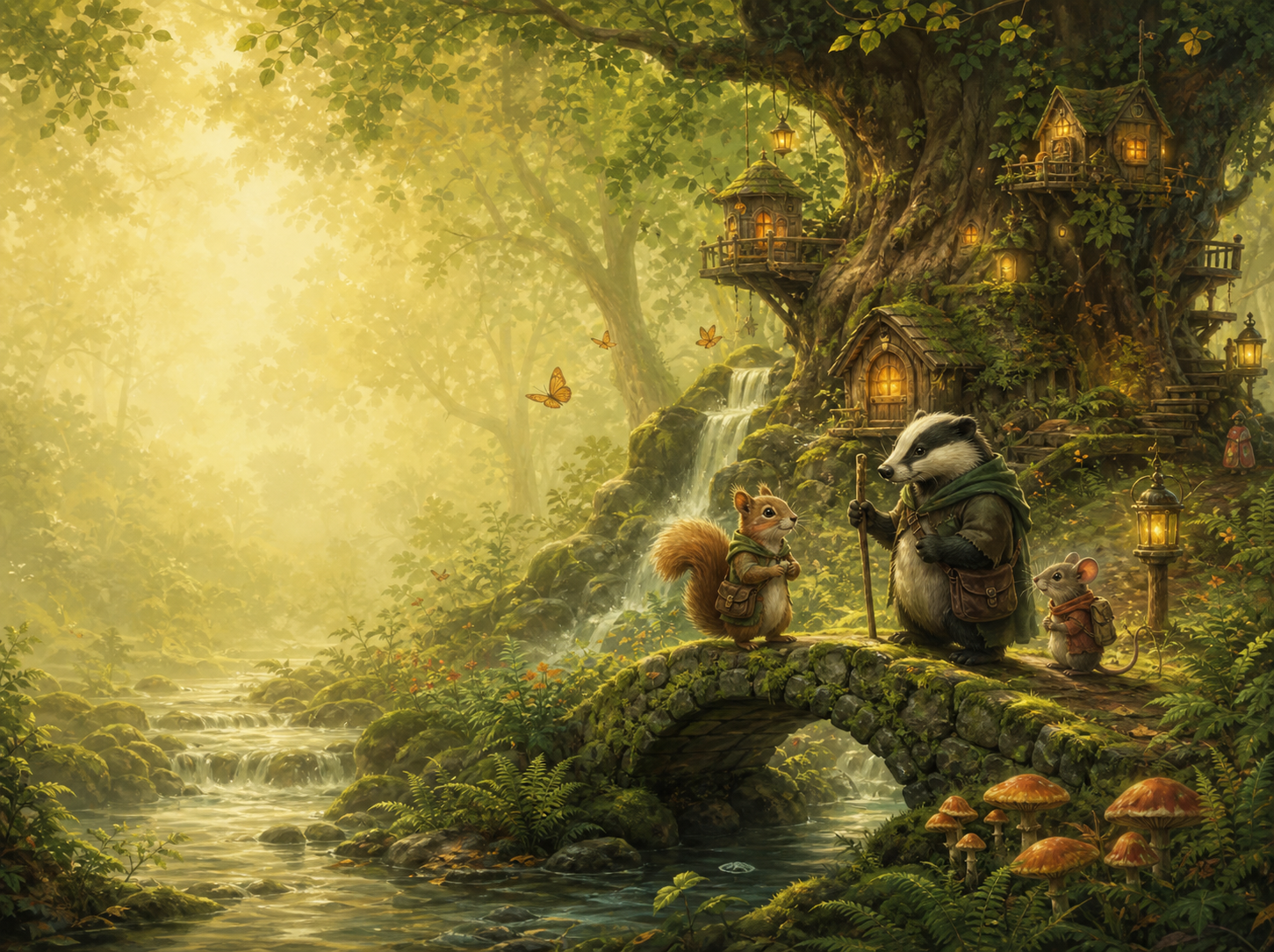
Everdell is a worker placement and tableau-building game set in a sun-dappled forest valley where woodland critters are building the cities of tomorrow. Over four seasons you deploy animal workers to gather resources and use those resources to construct buildings and recruit critters into your personal city — a tableau of up to fifteen cards, each adding points, abilities, or both.

The game has a satisfying physical centerpiece: a tall cardboard Ever Tree from which worker pieces hang at the start, tumbling down into play as the seasons change. Beneath the spectacle is a tight decision space where your card combinations snowball, and knowing when to "Prepare for Season" — trading your workers for fresh ones and a bonus — is the central tempo puzzle.

Setup

  1. Assemble the main board. Place the Ever Tree at one end of the board with the Critter and Construction tokens hanging from it, and lay out the basic location spaces along the river — each offering twigs, resin, pebbles, berries, or card draws.
  2. Set up Forest locations and the Meadow. Lay out the Forest location tiles (drawn randomly each game) and the shared Meadow of eight face-up cards from the shuffled card deck.
  3. Give each player their components. Each player takes a personal supply board, two starting workers, and a starting hand of 5 cards drawn from the shuffled card deck.
  4. Place event tiles and cards. Set out the basic event tiles and four randomly selected special event cards where all players can see them.
  5. Set player order and start in Winter. Determine the player order — the game begins in Winter.

How to play

On your turn you choose one of three options:

  • Place a worker — send one of your available workers to an open location on the board or on a card in your city. Basic locations provide resources (twigs, resin, pebbles, berries) or let you draw cards. Forest locations offer more powerful or flexible actions. Locations marked with a closed circle are exclusive; open circles allow multiple workers.
  • Play a card — pay the resource cost of a card from your hand or from the Meadow and add it to your city. Your city can hold a maximum of 15 cards. You may also play a card for free if it is a Critter that matches a Construction already in your city — cover the construction's critter icon with a token to show it has been used.
  • Prepare for Season — when you are ready, take this action to recall all your workers, gain new ones from the Ever Tree (one extra each season), and perform the season's bonus action. Spring and Autumn trigger all Production cards in your city, generating their resources for free; Summer lets you draw two cards from the Meadow.

Card types and their synergies are the heart of the game. Construction cards (brown/gray) provide resources, unlock free Critters, and grant passive abilities. Critter cards (tan) offer powerful active or passive powers. Both types earn points. As your tableau grows, city synergies can generate cascading resources, extra card draws, or bonus point-scoring opportunities.

Events can be claimed by any player whose city meets specific criteria — but claiming one requires placing a worker on that event's space on the board. Meeting the criteria alone does not claim it automatically. Basic events sit open on the board; special events require particular combinations of cards. Each claimed event scores points and is exclusive — once taken, it's gone.

How to win

The game ends when every player has taken their turn through Autumn and chosen to Prepare for Season or run out of workers. Players then count points from all sources: points printed on cards in their city, point tokens accumulated during the game, events claimed, and any Journey points scored by workers sent to the Journey space at game end.

Most winning cities hit 50–70 points. The best strategies combine a consistent resource engine to play cards cheaply, a handful of powerful synergy pairs (such as cards that trigger other cards for free), and at least one or two events. Because the card pool is large and the Meadow and Forest locations are randomized each game, no two games support exactly the same city design — adaptability and opportunism matter as much as a fixed plan.