
Tabletop Companion
en
← Learn

Field guide

How to play Catan: Traders & Barbarians

3–4 players (up to 6 with the 5–6 player extension) — requires the Catan base game Medium–high — five scenarios and four variants; the last two scenarios rival Cities & Knights

What is Catan: Traders & Barbarians?

Catan: Traders & Barbarians is Klaus Teuber's toolbox expansion — not one new game but five scenarios and four variants that let you rebuild the base game to taste. Some are small rule swaps you'll never play without again; others are full campaigns as deep as Cities & Knights.

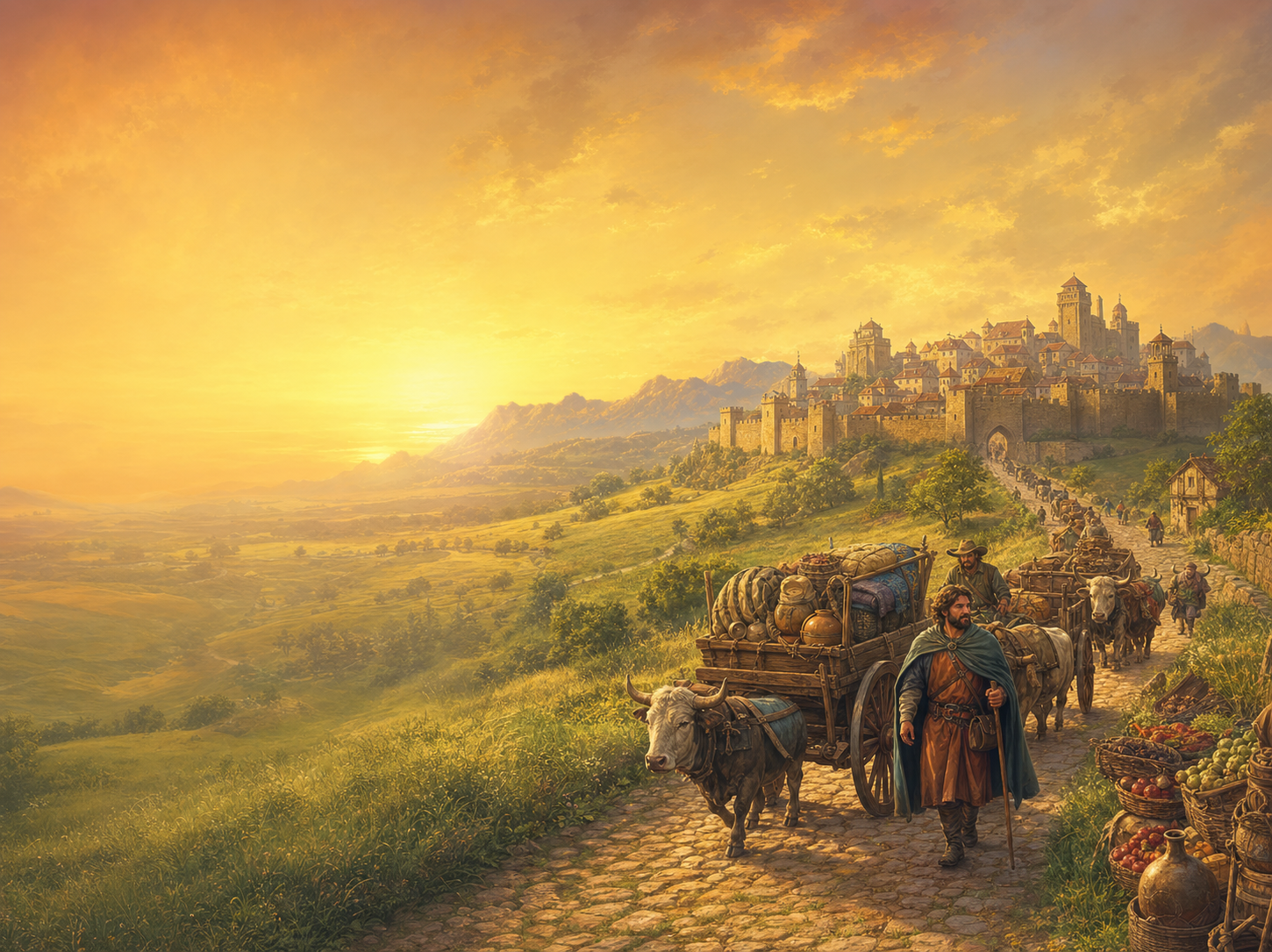
The variants are drop-in fixes: the Friendly Robber shields players who still have 2 or fewer victory points, Catan Event Cards replaces the dice with a statistically balanced deck, Harbormaster adds a new special card for coastal builders, and Catan for Two makes a genuine two-player game. The scenarios are full experiences: The Fishermen of Catan, The Rivers of Catan, The Caravans, Barbarian Attack, and the flagship Traders & Barbarians, in which you push a wagon along the roads of Catan hauling glass, marble, sand, and tools to rebuild the Castle.

Coming from base Catan? The mental shift is that roads stop being just a race for Longest Road and become infrastructure you actually drive on. In the title scenario, a road you built two turns ago is the difference between reaching the Castle this turn and stalling one intersection short — and a rival's road will carry your wagon too, for a gold coin toll.

Components

What's in the box, and what each piece does at the table:

  • 36 commodity tokens — the cargo of the title scenario: glass, marble, sand, tools. Drawn face down from three stacks, each one names your next destination and, once delivered, is worth 1 victory point plus gold.
  • 4 wagons (1 per color) — your truck. It lives on an intersection, spends movement points to travel the road network, and is the only way a commodity ever reaches its buyer.
  • 20 baggage train cards (5 per player) — your upgrade track. Each card shows three numbers: your wagon's movement points, the gold you earn per delivery, and the die roll that drives off barbarians. Upgrading costs resources; reaching the last card is worth a victory point.
  • 36 barbarians — bronze figures that squat on paths. Only one per path, and driving through one costs +2 movement points — the traffic jam that ruins carefully planned routes.
  • 40 gold coins (25 small, 15 large) — the expansion's cash. Earned on delivery, paid as tolls when you use another player's road.
  • 17 terrain tiles, fishing-ground tiles, and sea frame pieces — the new land: the Castle, Quarry, and Glassworks trade hexes (each with a central plaza your wagon drives into), plus river and lake hexes for the other scenarios.
  • 24 knights (6 per color) — for Barbarian Attack, where knights are built to fight the invasion rather than to steal.
  • 22 camels + 21 trade tokens — the caravan pieces and the trade currency of The Caravans.
  • 30 fish tokens — the catch in The Fishermen of Catan, spent as a flexible mini-currency.
  • 12 bridges (3 per color) — cross the rivers in The Rivers of Catan.
  • 120 cards — including a 36-card event deck that can retire the dice entirely, 25 new development cards for the title scenario, and the Harbormaster special victory point card.
  • 4 special tiles — the "Wealthiest Settler" and three "Poor Settler" markers used by the river scenario.

Setup

First, agree what you're playing. Variants stack freely with each other and with the scenarios; scenarios are played one at a time. Each scenario's sheet has its own setup and victory condition, so settle this before anyone touches a hex — the answer changes where you'd want to settle.

Setup for the flagship Traders & Barbarians scenario:

  1. Rebuild the coastline. Swap two base-game frame pieces (labeled 1–2 and 5–6) for the expansion's sea frame pieces.
  2. Install the three trade hexes. Remove the desert, one pasture, and one fields hex from the base game and place the Castle, Quarry, and Glassworks hexes so each one's sea side meets the frame. Trade hexes produce no resources and get no number token — they're destinations, not income.
  3. Place number tokens as in base Catan but skip the trade hexes, and remove the "2" and "12" tokens from play. With three hexes gone, the board has fewer production spots — expect resources to be tighter than you're used to.
  4. Stack the cargo. Sort the commodity tokens into three stacks by the building on their backs (castle, quarry, glassworks), shuffle each, and set it face down beside its matching hex.
  5. Set the board dressing. Place 3 barbarians on the marked paths, use only the expansion's 25 development cards, and put away the robber and the Longest Road card — neither exists in this scenario.
  6. Equip each player. Take your 5 baggage train cards, stack them in order 1–5, and flip the top one face up as your active card. Take 5 gold.
  7. Settle differently. Place your starting pieces as in base Catan, except your second settlement is a city — and you still only collect 1 resource per hex touching it. Park your wagon on your city's intersection. Starting with a city means you're producing double from turn one; the expansion assumes you'll be spending heavily on both building and hauling.

How to play

Turns keep the familiar Catan rhythm — roll for production, trade, build — and then, in the title scenario, add a fourth step: move your wagon.

Moving. Your wagon travels intersection to intersection, spending movement points (MPs) — 4 to start, more as you upgrade. Each path costs: - 2 MPs with no road on it, - 1 MP on one of your own roads, - 1 MP on another player's road, plus 1 gold paid to them, - +2 MPs on top of all that if a barbarian is standing on the path.

You may pay 1 grain once per turn to buy +2 MPs, even mid-move. Unused MPs are lost, you can never partly cross a path, and you must stop the moment you enter a trade hex's central plaza.

Hauling. Reach a trade hex's plaza and draw the top commodity token from its stack — that token names your next destination: glass and marble go to the Castle, tools to the Quarry, sand to the Glassworks. Deliver it and turn it face down: it's worth 1 victory point and pays you 1–5 gold depending on your baggage train. Then immediately draw a new commodity there, which sets your next run. You can only ever carry one at a time, so the game becomes a continuous loop of deliveries.

Upgrading. During your build step, pay the resources shown on the next baggage train card to flip it up as your new active card — buying more movement points, richer delivery payouts, and a better number for scaring off barbarians. The final upgrade is itself worth a victory point.

A turn, played out. Ana's wagon sits on the Glassworks plaza holding a sand token she can't deliver there. She rolls, collects, then spends 1 grain for +2 MPs, giving her 6. The direct route to the Glassworks runs 2 paths over her own roads (2 MPs) and one roadless path (2 MPs) — but a barbarian squats on the last one, pushing it to 4. She'd be 2 MPs short. Instead she detours over Beto's road (1 MP + 1 gold to Beto) and arrives with an MP to spare. She flips the sand face down: 1 victory point, 2 gold from her current baggage card, and she draws a fresh tools token — her next destination is the Quarry.

How to win

Each scenario sets its own finish line. In the flagship Traders & Barbarians scenario, the first player to reach 13 victory points on their turn wins — a higher bar than base Catan's 10, because there are more ways to score.

Your points come from four places: settlements and cities as always, every delivered commodity token (1 VP each), the final baggage train upgrade (1 VP), and development cards. Note what's missing: with no robber and no Longest Road card, two of base Catan's classic point sources and its main disruption tool are gone.

Strategically, the expansion rewards thinking of your road network as a delivery route rather than a land grab. Build the roads that shorten the loop between two trade hexes you'll be visiting repeatedly, and remember every rival road you drive is a gold coin donated to an opponent. Upgrade the baggage train early rather than late — more movement points don't just make trips faster, they make trips possible that a barbarian would otherwise block, and the payout per delivery rises for the rest of the game. And keep a grain in hand: the +2 MP purchase turns an aborted trip into a delivery more often than any other single decision in the scenario.

Across the whole box, one rule of thumb holds: pick the scenario for the group you have. The Fishermen of Catan and The Friendly Robber soften the game for families and new players, while Barbarian Attack and Traders & Barbarians are for tables that already find base Catan a little tame.